
Editorial
The Complete History of the Big Muff Pi
From Jimi Hendrixbuying one of the first units at Manny's Music to Billy Corgan's wall of fuzz — the pedal that survived bankruptcy, a Russian military factory, and 55 years of genre changes
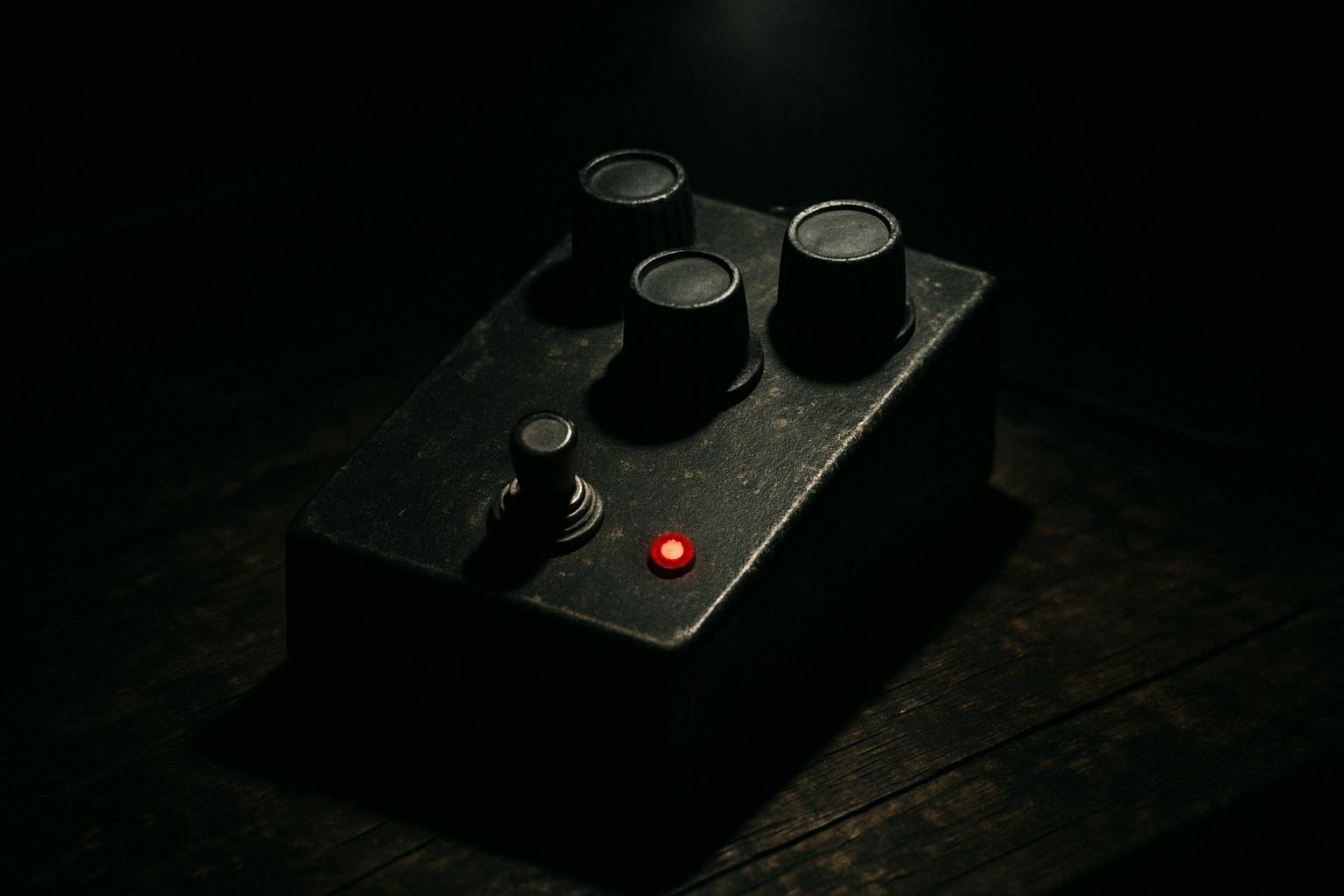
Mike Matthews sold the first Big Muff Pi to Jimi Hendrix. That is not a marketing claim — it is a documented fact that Matthews has repeated in multiple interviews over the decades. He brought the first units to Manny's Music on West 48th Street in Manhattan in late 1969. Henry, the man who ran the store, called Matthews a week later. Jimi Hendrix had been in and bought one. Matthews later attended a Hendrix recording session and saw the Big Muff sitting on the floor by the amp.
That is the origin story. What followed was 55 years of bankruptcy, Russian military factories, alternative rock, and an argument about circuit versions that has never fully resolved. The Big Muff Pi (Reverb) is the most version-obsessed pedal in history after the Tube Screamer — and unlike the Tube Screamer, its versions sound genuinely, dramatically different from each other.
The Circuit That Started Everything
Mike Matthews founded Electro-Harmonix in 1968, having spent the previous years building fuzz pedals for other companies — including the Foxey Lady, sold through Guild Guitar Company and named after the Hendrix song. The Big Muff Pi was co-designed with Bob Myer, a Bell Labs engineer Matthews knew personally. Matthews wanted a distortion pedal with unusually long sustain — more than any existing fuzz box could produce. Myer's solution was elegant: cascade four transistor gain stages in sequence, each one clipping the signal through a pair of silicon diodes. By clipping the signal twice in succession rather than once, the circuit could produce sustained distortion at gain levels that single-stage fuzz boxes couldn't reach.
Matthews then spent several days adjusting capacitor values to roll off the harshness that aggressive clipping produces in the upper frequencies. His target was what he described as a "sweet violin-like sound" — smooth, warm, and capable of sustaining notes long after the pick attack faded. The tone control — a passive network combining a high-pass and low-pass filter blended by a single potentiometer — introduced a midrange scoop at 1kHz when set to its center position. That scoop is the Big Muff's most distinctive sonic characteristic: it carves out the frequency range where guitars most commonly compete with vocals and other instruments, producing a thick, wall-like quality that sits differently in a mix than any other distortion circuit.
The circuit is not a fuzz in the strict sense — Electro-Harmonix has always marketed it as a "distortion/sustainer." The distinction matters technically. A Fuzz Face (Reverb) or Maestro Fuzz-Tone clips the signal through a relatively simple two-transistor circuit that produces ragged, asymmetrical waveforms. The Big Muff's four-stage cascade produces more symmetrical clipping with controlled high-frequency rolloff, which is why it sounds smoother and more sustained than a Fuzz Face at similar gain settings. From a circuit standpoint it sits between fuzz and distortion — which is why different players have used it in different genre contexts without it sounding out of place in any of them.
The Versions: Why They Actually Sound Different
The Big Muff went through numerous circuit variations between 1969 and 1984, most of them resulting from component substitutions as parts became unavailable rather than deliberate redesigns. Four versions matter:
Version 1 — Triangle (1969–1973): Named for the triangular layout of its three knobs. The earliest units used NPN silicon transistors with specific capacitor values that produced a brighter, more open sound than later versions — more sustain in the upper midrange, less bass emphasis. David Gilmourused a Triangle-era Big Muff on Pink Floyd's Meddle. The original Triangle units now sell for several hundred dollars; the EHX Triangle Big Muff reissue (Reverb) from 2018 is a faithful recreation at a fraction of the price.
Version 2 — Ram's Head (1973–1977):The enclosure grew, the artwork gained the ram's head motif, and the circuit shifted. The Ram's Head has less midrange, more gain, and more bass weight than the Triangle. It is darker and heavier. David Gilmour adopted a Ram's Head for Pink Floyd's Animals and used it through The Wall. J Mascis of Dinosaur Jr. has played Ram's Head Big Muffs (Reverb) almost exclusively for 40 years. The tone on "Freak Scene," "The Wagon," and virtually every Dinosaur Jr. album since Bug is Ram's Head through a cranked amp — the specific combination of the Ram's Head's low-mid emphasis and the power amp distortion of a pushed Marshall or Hiwatt produces a crushing sustained tone that no other pedal into the same amp can replicate.
Version 4 — Op-Amp (1977–1979): This is the one Billy Corgan used on Siamese Dream. Where every other Big Muff version uses transistors for its clipping stages, the Op-Amp version (Reverb) substitutes an integrated circuit op-amp chip for the transistor gain stages. The result is a harder, more compressed, and more mid-forward distortion than any transistor Muff — cutting through a dense mix in a way that the Ram's Head, with its mid scoop, does not. Corgan stacked multiple Op-Amp Big Muffs and recorded the same part dozens of times to build the wall-of-sound guitar textures on Siamese Dream.
Version 5 — Soviet/Sovtek (1992–2000): When Electro-Harmonix went bankrupt in 1984, Matthews relocated production to a Soviet military electronics factory in Leningrad. The Sovtek Big Muff (Reverb) uses different transistors and different capacitor values from any American version, producing a smoother, bassier, less aggressive sound that is immediately recognizable. Thurston Moore and Lee Ranaldo of Sonic Youth played Sovtek Big Muffs throughout the 1990s. The Sovtek versions are the Big Muffs most closely associated with the shoegaze and noise rock sounds of that decade.
The Artists Who Defined It
The Big Muff's survival across five decades is inseparable from the specific artists who adopted it. Each one used it in a context that demonstrated a different dimension of what the circuit could do — and each one influenced the next generation of players who bought the pedal specifically to get that sound.
David Gilmour is the most technically careful of the Big Muff players. His use of it on Pink Floyd records was always in service of specific melodic lines — the sustain was a compositional tool, not a texture. The lead on "Comfortably Numb" runs through a Ram's Head Big Muff into a Hiwatt DR103with the volume wound up. The pedal provides the initial gain and the characteristic smooth clipping; the power amp provides the warmth. The combination produces a tone that sustains almost indefinitely while retaining the note's pitch definition — something neither element achieves alone.
J Mascis treats the Big Muff as a genre unto itself. His approach is maximalist — high gain, guitar volume on full, amp pushed hard. The Ram's Head does not clean up when you roll back the guitar volume, as a germanium Fuzz Face does. Mascis does not want it to clean up. He wants the full gain at all times, and he adjusts his dynamics through picking attack. The result is a guitar sound where the quietest note and the loudest note occupy roughly the same dynamic space — an effect that sits between distortion and compression that no studio compressor can replicate.
Billy Corgan approached the Big Muff as a studio instrument. The guitars on Siamese Dream were not played through single Op-Amp Big Muffs. They were the product of dozens of passes, multiple simultaneously activated Op-Amps, and months of studio experimentation with producer Butch Vig. The "wall of guitars" sound on "Cherub Rock" and "Soma" is the Op-Amp Big Muff's mid-forward compression multiplied across dozens of tracks — something that cannot be replicated by a single pedal in a live context, which is why Corgan's live Big Muff tones have always sounded different from the records.
The Reissues and the Clone Market
When Electro-Harmonix resumed American production in 2000, it faced a problem: the Big Muff had been out of American production for sixteen years, the Sovtek versions were still available, and a substantial market of players had grown up on specific vintage versions that no longer existed. The company's solution was a combination of a standard reissue (the NYC Reissue, based on a late-1970s circuit) and, eventually, specific reissues of the Triangle, Ram's Head, Op-Amp, and Sovtek versions.
The reissue versions are faithful but not identical to the originals. Component tolerances in production transistors and capacitors vary more widely than in military-spec parts, and the specific transistors used in the original Triangle and Ram's Head — 2N5133 and 2N5088 types — are no longer manufactured. The reissues approximate the sound using modern equivalents. For most players the difference is inaudible. For the people who care about this, the difference matters enormously.
The clone market exists because the Big Muff circuit is simple enough to build from scratch and the original component values are well-documented. The Way Huge Swollen Pickle (Reverb), the EarthQuaker Devices Hizumitas (Reverb) — the signature pedal of Wata from Boris, one of the most influential heavy guitar players of the last 20 years — and dozens of boutique variants all trace their lineage directly to the four-stage cascade circuit that Bob Myer designed in 1969.
Why It Survived
Most pedals that achieve cultural significance do so in a specific genre context and stay there. The Tube Screamer is an overdriven blues pedal adopted by country players and extended to hard rock. The Fuzz Face is a 1960s psychedelia pedal with a second life in grunge. The Big Muff crossed from psychedelia to prog rock to alternative to shoegaze to heavy metal without modification. The same circuit that Hendrix used in 1969 is the circuit that Boris uses today.
The reason is the midrange scoop. By carving out 1kHz, the Big Muff creates space in a mix that other distortion pedals do not. In a genre context where guitars need to share space with vocals, the scoop is a problem — which is why the Big Muff does not work well for clean blues or country rhythm playing. But in any context where guitars are the primary texture — where the point is wall-of-sound density rather than presence in a vocal mix — the midrange scoop becomes an advantage. It allows the guitar to fill the entire sonic space without competing with itself.
Matthews understood this intuitively in 1969, even if he would not have described it in those terms. He wanted a pedal that sounded like a sustained violin — warm, smooth, and capable of filling a room. The circuit he and Myer built achieved exactly that. The fact that it did so through a mechanism — the midrange scoop — that turned out to be useful in genre after genre was luck as much as design. But the design was good enough that the luck stuck.
Fifty-five years later, the Big Muff Pi is still in production, still being counterfeited, still being cloned, and still being argued about by people who have strong opinions about transistor tolerances. That is not a legacy that happens by accident.
Loading comments...